


If You Can Hear Mozart, You Are Mozart
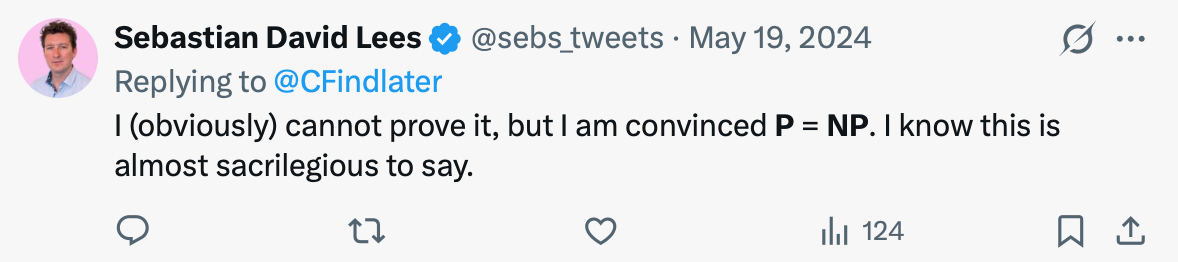
I have always believed that P=NP. I am no mathematician, but from a philsophical point of view, it seems obvious. Tell a room of theoretical computer scientists that P might actually equal NP, and you will be met with the pained grimace usually reserved for someone who has just announced that the Earth is flat.
In complexity theory and mathematics, the dogma is holy: for certain problems, verifying a solution (NP) is trivial; finding one from scratch (P) is agonising (if not impossible). To hammer home just how preposterous the alternative would be, MIT complexity theorist Scott Aaronson deployed the following thought experiment:
"If P=NP, then the world would be a profoundly different place than we usually assume it to be. There would be no special value in “creative leaps,” no fundamental gap between solving a problem and recognizing the solution once it’s found. Everyone who could appreciate a symphony would be Mozart; everyone who could follow a step-by-step argument would be Gauss; everyone who could recognize a good investment strategy would be Warren Buffett."
To a common sense mind, this settles the matter. Mozart was a once in a century outlier; you are an operations director who went to the Royal Festival Hall to listen to the second movement. The idea that sitting comfortably in Row G sipping warm Pinot Grigio is computationally equivalent to composing a Requiem sounds laughable.
Except this reveals a rationalist blind spot: economists and mathematicians always assume that consumption is a passive act.
They treat the listener like a barcode scanner: a low-cost optical sensor simply registering someone else's product. But neuroscience tells a completely different story. Human perception is an act of ferocious internal simulation. When you listen to Mozart, your brain doesn't record audio like a dictaphone; it actively reconstructs the tonal architecture in real time, anticipating harmonic trajectories, feeling tension, and resolving complex counterpoint.
A symphony played in an empty forest isn’t music. It only converts into art when it strikes wetware sophisticated enough to mirror the neural patterns of the person who conceived it. To genuinely appreciate Mozart, you have to run Mozart’s cognitive operating system. Verification is not an administrative rubber stamp; it is creation in reverse. In the same way that differential and integral calculus are two sides of the same coin, so too are creation and verification.
For two centuries, mathematicians have conflated the mechanical friction of craft with aesthetic genius. We assumed Mozart’s brilliance lived in his ability to endure twenty years of finger cramps scribbling ink onto parchment.
Generative AI is currently demolishing that illusion. When an algorithm can spit out forty symphonies in six seconds, the mechanical cost of production drops to absolute zero. The bottleneck ceases to be execution and collapses entirely into taste, curation, and perception.
Aaronson intended his thought experiment as an impossible dystopia. Yet by making execution instant and free, modern AI might inadvertently prove the philosophers right: the moment creation costs nothing, the person who knows what sublime sounds like really is Mozart.
P=NP. I will die on this hill.
Oct 28, 2026
If you've made it this far I owe you a beer the next time I see you 🍺. Want to get in touch? Follow me on X.
PLEASE NOTE: I used AI to refine, critique, and polish some of my articles.
